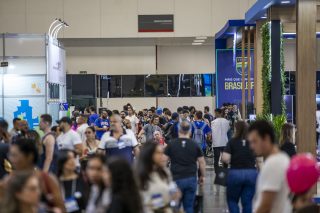
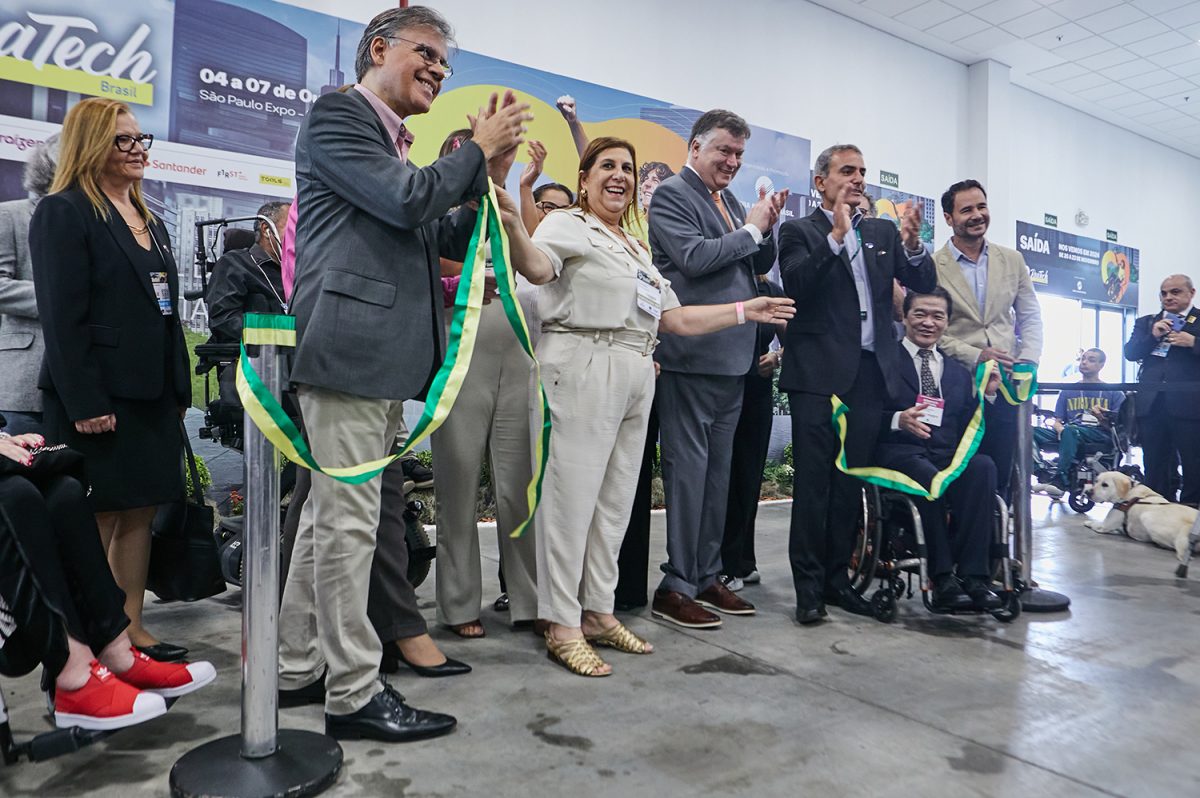
The opening ceremony of the 18th Reatech – International Fair for Inclusion, Accessibility, and Rehabilitation, opened to the public this Wednesday (Oct 4) at the São Paulo Expo, was attended by representatives of the São Paulo state government, leaders of 27 associations, and professionals working in various areas of the sector.
Maurício Macedo, CEO of Fiera Milano Brasil, promoter and organizer of Reatech, announced changes to the venue and also the date of the event in 2024. “We will return to Pavilion 1, where we have always been, between November 20 and 23. It is a pleasure to be here, meeting friends and partners. We are paving a path of inclusion and dignity. Reatech is the apple of our company's eye and we want it to grow more and more,” the executive stated.
Also present at the opening were Marcos da Costa, Secretary for the Rights of Persons with Disabilities of the State of São Paulo, Silvia Grecco, Municipal Secretary for Persons with Disabilities of the City of São Paulo, and Liana Pires, director of GATI (Integrated and Therapeutic Approach Group).
Representing all the event's partners, Liana Pires highlighted the improvements that have been made throughout Reatech's history. “The fair has innovated and is more humanized. I also thank all the partners and greet the participants. Only those who have come once know the love it is to be in here,” she said.
A visitor to Reatech accompanied by her son Nickollas, who is blind and autistic, Silvia Grecco took the opportunity to invite those present to visit the city hall booth. “Mayor Ricardo Nunes sends a warm hug to everyone present at this very important and necessary event. We are here to present some of the department's services, which cannot be found even in private clinics,” she commented.
Next to the city hall booth is the São Paulo State Government booth, featuring provided services in addition to offering a series of activities. “I bring a hug and thanks from Governor Tarcísio de Freitas and reinforce the importance of the event, congratulating those who invest in Reatech, growing every year. It is a victorious project, for a cause of society as a whole,” concluded Marcos da Costa.
Reatech Congress expands the debate on policies and actions for the inclusion of people with disabilities in the labor market
Although companies have total freedom to act in the inclusion of people with disabilities in the labor market, affirmative public policies are absolutely essential for inclusion to be full. This is the shared vision of the participants of the 2nd Reatech Congress on Inclusion and Accessibility in the Labor Market, opened today (Oct 4) at São Paulo Expo. The event, which runs until Friday, brings together professionals linked to Inclusion, Diversity, Accessibility, Human Resources, and Corporate Health in organizations from all over the countrys.
They participated in the opening panel“Debate on Government Policies for Inclusion in the Labor Market and Their Practical Application in Organizations, Renato Pacheco, Consul-General of Sweden in São Paulo, João Batista, Judge of the Regional Labor Court of Campinas, José Silvio da Silva Barreto, Counselor of the State Council for Persons with Disabilities of the State of São Paulo, Flávio Gonzalez, coordinator of Social Inclusion at the Jô Clemente Institute, and Adriano Bandini, Diversity, Equity, and Inclusion specialist at Itaú Unibanco. The moderation was conducted by Marcelo Pires, CEO of Consolidar.
The fundamental role of government policies in the inclusion of people with disabilities was highlighted by Gonzalez when explaining the methodology known as Supported Employment, which has been applied in various countries around the world since the 1980s and depends on government support to be executed with quality. The premise of this methodology is to include in order to qualify, which inverts the more common logic that preaches qualifying in order to include.
“For a long time, people with disabilities have been qualified, but they are never adequately included,” states Gonzalez. He explains that, in the Supported Employment model, individuals are first assessed and understood in their individuality before companies are prepared to welcome them.
Bandini emphasizes that this model has its costs and therefore the support of government actions becomes indispensable. He illustrates this by talking about projects in which he works, such as the one that generates inclusion for people with intellectual disabilities. Bandini recounts that this is work which, to be effective, requires individualized monitoring, with a frequency that varies from person to person.
“Public policy is fundamental because it also gives direction for companies to act on what needs to be done,” reinforces the Diversity, Equity, and Inclusion specialist at Itaú Unibanco. “Laws and regulations provide legal certainty and help guide the actions of the private sector.”
Pacheco brought to the discussion the view of shared responsibility, which is common in Sweden. “The responsibility of caring for people with disabilities does not lie solely with the family. This must be a management shared by society as a whole, including companies, schools, governments, and institutions.”
With practical experience in labor matters, Batista points out that companies need to go beyond simply complying with the law. “Often, we see that the quota law is complied with, but the company does not worry about developing a culture of inclusion. Without this, inclusion does not become effective,” clarifies the appellate judge. “The quota law is important, but more important is building a truly inclusive society.”
Born with osteogenesis imperfecta, a rare disease that affects one in 20,000 people, Barreto recounted his journey, from the obstacles in completing his formal education to the development of his professional career. He highlighted the importance of people with disabilities seeking qualification and also occupying spaces so that their presence reinforces in society the perception that they are fully capable individuals. “Whoever was at college had to see me there at college, whoever was at work had to me see me there at work. It's a way for them to understand that I am also a person.”
Infrared camera technology increases the accuracy of gait analysis
“In rehabilitation, gait is the pinnacle of our goals,” states Débora da Silva Fragoso de Campos, a physical therapist at the Movement Study Laboratory of the Israelita Albert Einstein Hospital and a certified Lokomat Clinical Instructor in Brazil by Hocoma. Campos was one of the speakers on the first day of Reamed – Congress of Physical Medicine and Rehabilitation, which is part of the schedule of Reatech Brazil, the International Fair for Inclusion, Accessibility, and Rehabilitation.
The physical therapist talked about a gold standard evaluation, which allows for a better approach to the patient, to understand the best procedures to be taken given the current condition of the person being evaluated and whether the proposals already carried out have had an effect and were adequate.
“With the aid of infrared cameras, which capture light using markers on specific points of the body, it is possible, during walking, to accurately analyze angles and muscle contraction, for example. Since we have a very well-established standard of what is normal, we know that anything deviating from this is a pathological issue, states Campos.
According to the physiotherapist, the exam can be performed on children starting at four years of age, both for physiological and practical reasons. “It's an evaluation that takes about three and a half hours, which can be a lot for a child. Furthermore, gait maturation happens starting at four or four and a half years old,” she explains.
Extreme sports promote autonomy and independence for wheelchair users
Valdir de Souza's wheelchair status led him to become a professional athlete, something he had never aspired to or imagined possible before suffering a workplace accident. Valdir watched his autonomy and independence vanish when he ended up in a wheelchair. However, his reality changed when he became the first athlete of the Faca na Cadeira Institute, a non-profit association founded in 2018 with the goal of promoting parasports as a means to aid rehabilitation for people with physical disabilities.
Valdir is a WCMX (Wheelchair Moto Cross) athlete, an extreme wheelchair sport on skate parks with obstacles. This practice has led the athlete to represent Brazil twice in world championships. He participates in the activities of the “Faca na Cadeira” circuit, one of the attractions at Reatech, which runs until Saturday at São Paulo Expo.
“Before sport, I had no autonomy. Today I leave the house by myself, push my chair, do wheelies. We show the other side of the person with a disability. The thing I hear most from the people who come to Faca na Cadeira is that they want to have a normal life and autonomy, to have the freedom to do things without having to keep asking people, the athlete recounts.
Reatech visitors can issue the Autism Spectrum Disorder Identification Card for free
The State Secretariat for the Rights of Persons with Disabilities is offering the free issuance of the Identification Card for Persons with Autism Spectrum Disorder (CipTEA) at its booth at Reatech, which runs until Saturday at São Paulo Expo.
The ID card is an official document that facilitates the identification of a person with Autism Spectrum Disorder (ASD) in public and private services throughout the state of São Paulo, in addition to helping guarantee rights provided by law, such as priority lines and services.
To issue it, it is necessary to present a photo ID, a 3x4 photo, proof of address, and a medical report certifying the ASD diagnosis with the ICD code, date, signature, and professional registration number (CRM) of the responsible physician.
According to a statement from the department, the official document is of utmost importance for people with ASD because it helps with identification and rights provided by law, such as priority lines and services in public and private facilities throughout the State.
Vehicles can be adapted to the needs of the person with a disability
The Mercedes-Benz and Fiat booths at the 18th edition of Reatech – International Fair for Inclusion, Accessibility and Rehabilitation have a clear mission: to show that motor vehicles can be adapted to the needs of people with disabilities. In addition to showcasing new cars, the brands want to promote the best solutions for this consumer group.
“We have an effective operation in these converted cars; there is high demand from city halls and government agencies. Our cars have enormous adaptation flexibility, and we customize according to each need to best serve [our clients]. We have several implementers, providing options and solutions, explains Lauro Marques, sales consultant at Mercedes-Benz.
Paulo Mesquita, Fiat's sales manager, adds by pointing out that the market is heating up again. “It was harmed by government issues and the pandemic. Our intention is to bring the news. We are sure we will be successful, showing the facilities that people with disabilities can find,” he concludes.
Wheelchair basketball competition at Reatech has five players called up for the Parapan American Games national team
The court of ADD (Sports Association for the Disabled) at the 18th edition of Reatech – International Fair for Inclusion, Accessibility, and Rehabilitation is hosting a wheelchair basketball competition. The internal tournament, however, features a high technical level, with the participation of four athletes called up to represent Brazil at the Parapan American Games in Santiago, Chile, in October 2023.
Amauri Viana, Cristiano Junior, Serginho, and Wallace Carvalho were called up last Tuesday (3) to represent the country in the tournament taking place from November 17 to 26. Assistant coach Sileno Santos is yet another name who will also be at the competition.
The expectation of the Brazilian National Team is to manage to get on the podium in Santiago. In addition to the medal, the team aims to secure a spot at the Paris Paralympic Games in 2024. “The champion gets a direct spot and the other two compete in the world repechage. There is still a lack of some incentive, but we are improving,” comments Serginho, who was introduced to the sport precisely at the event.
As a child, she came alongside her mother as a visitor and discovered a great passion there. “This event is very important, because many people don't know what a Paralympic sport is. It can change a person's life, as was my case. I lived in Paraná, without opportunities, and I found this chance here. Sport helped me with my independence, my autonomy, and gave me a purpose in life,” she comments.
Reatech showcases solutions in accessibility, rehabilitation, and communication
The first day of Reatech brought many new developments for those who visited the booths of the International Fair of Inclusion, Accessibility and Rehabilitation, the main event in Latin America. Exhibiting brands from different market segments are presenting technologies and equipment that will make daily life easier for people with disabilities. These are devices that help, for example, turn on a light or even communicate through an app, offering a better quality of life and autonomy.
Anyone who visited the Colibri booth was able to test the numerous features of “Conversia,” a device that converts any facial gesture or head movement into communication with smart device controls. A person who lacks arm movement or has lost their speech can, simply by moving their head or face, access commands such as changing a TV channel or turning off house lights, and most importantly, communicate through artificial intelligence. The device forms words and phrases using the voice tone of the person using the equipment (without a mechanized voice).
“When we have the user's recorded voice, the device is able to reproduce that voice, which ends up being very emotional for the user and their loved ones. Even though they can no longer speak, the person is able to communicate by forming sentences using only movements like moving the head and blinking,” explains Adriano Assis, CEO of Colibri. Still according to the executive, this technology brings together several commands in a single device, doesn't need wires, it's just like a tablet itself, the device learns its user's functions on its own, with the person's command, helps with daily tasks, can access applications and even play games, giving more autonomy and communicability to its users.
Accessibility
At the Kitlivre booth, wheelchair users can find various product options. The company has been at Reatech since 2015. The new product this year is the “Cadeira Original” (Original Chair), which adapts to the measurements of its users, with anatomical adjustments that allow a person with a seat width of 36 or 48 centimeters, which ultimately extends the lifespan of the chair.
Julio Oliveto Alves, CEO of Kitlivre, explained that the chair can be used by a person from childhood to adulthood. “It is a chair that greatly extends the time between replacements; it is equipment designed for the long term, which can serve the same person for many years as it adapts to size and weight,” he commented.
Reading
Another interesting new product at Reatech 2023 is the Omni Reader device by Tecassistiva, which allows blind people or those with some degree of visual impairment to read a book or printed text, not only through the traditional braille method, but also as a listener. The device captures a book page through a photograph and conveys the information contained in the print via audio. When connected to another company device, the Focus Blue, a person can simultaneously listen and read using the braille method.
“The equipment allows blind people or those with visual impairments to access printed content—a book, a magazine, a newsletter—in a simple way. People can listen to the content or use headphones for more privacy. And for people with low vision, the screen and text can be enlarged,” explains Wagner Bispo, commercial manager at Tecassistiva.
Service:
Reatech 2023 – International Fair of Technologies for Rehabilitation, Inclusion and Accessibility
October 4 to 7
Hours: from 1 PM to 8 PM on the 4th, 5th, and 6th; from 10 AM to 7 PM on the 7th
Location: São Paulo Expo – Pavilions 3 and 4
Address: Rodovia dos Imigrantes, 1.5 km – Vila Água Funda, São Paulo – SP
Free transport starting from 1 hour before until 1 hour after the street market's operating hours. Departure from Santos-Imigrantes Subway Station – R. Engenheiro Guilherme Winter, s/n.
More information in this link.
Photo gallery Link
About Fiera Milano Brasil
Fiera Milano Brasil it is Brazilian subsidiary of Fiera Milano, one of the world's largest trade fair and congress players, which each year attracts approximately 30,000 exhibitors and more than five million visitors. In Brazil, there are seven fairs representing the most diverse segments of the economy, such as security, clean and renewable energies, pipes and fittings, cables, occupational health, rehabilitation technologies, inclusion and accessibility, among others. Among the main brands in the portfolio are Exposec, Fisp, Fire Show, Congresso Ecoenergy, Reatech, Tubotech and Wire South America. More information: www.fieramilanobrasil.com.br
Press Information
2PRÓ Comunicação
Myrian Vallone | Teresa Silva
Team email: fieramilano@2pro.com.br
11-3030-9463 |3030-9404 | 99228-7836