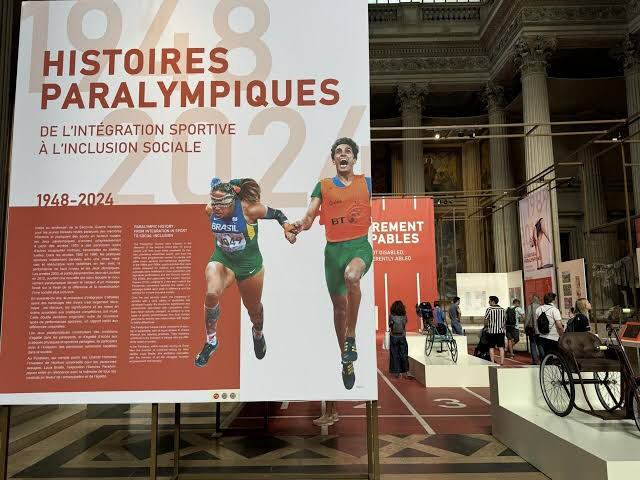
“Paralympic Stories – from sports integration to social inclusion, currently on display at the Panthéon in Paris, provides an overview of the Paralympic sports phenomenon, from its origins to the present day. The exhibition takes place alongside the Paris 2024 Paralympic Games.
Through period posters, photographs of historical moments, and film sequences, the visitor follows the development of sports for people with disabilities, from the first competitions, called “hospital” competitions, held at Stoke Mandeville Hospital in the United Kingdom under the supervision of Dr. Ludwig Guttmann in 1948, passing through Rome, where the first Paralympic Games took place in 1960—at the time exclusively for wheelchair users—until progressively encompassing all people with disabilities, as is the case today.
It is an exhibition that follows a historical axis and seeks to show the historical evolution of this sports movement, which was born at the end of the Second World War and underwent major development during the second half of the 20th century. And, since, say, the 2000s, it has been becoming increasingly media-driven, which was not the case before, explains Anne Marcellini, a specialist in the sociology of sport at the University of Lausanne, in Switzerland, and co-curator of the exhibition, along with Sylvain Ferez.
In the beginning, this sport was conceived by doctors to help in the physical rehabilitation of wounded young war veterans. But the idea that this rehabilitation should also help these young people return to social and professional life quickly took root as well,” he adds.
The impacts of this evolution are also reflected at the social level, with a change in the way the world views disability. Before the Paralympic Games, people with disabilities lived more isolated lives, in a less visible way,” explains Barbara Wollfer, administrator of the Pantheon. “This issue of visibility is very important. The Paralympic Games put the body in the spotlight, and this visibility changes the way people perceive those with disabilities. So, a very important dimension of this exposure is to showcase this and go beyond the purely sporting issue,” she adds.
The exhibition route was also designed for visitors with disabilities. In addition to visual material, there are audio descriptions, texts, Braille documents, and explanations in French and international sign languages. There are prosthetics and old wheelchairs, alongside their more modern versions. The exhibition also features Games mascots and doll versions, such as Barbie, with disabilities.
The imposing Pantheon building in Paris, atop Mount Saint Genevieve in the 5th arrondissement of Paris, was built between 1759 and 1790 at the request of King Louis XV. The building houses the remains of great figures in French history, such as the philosophers Voltaire and Rousseau, the writer Victor Hugo, the scientist Marie Curie, the US-born artist Josephine Baker, and Simone Veil, a Holocaust survivor and politician who championed the abortion bill in 1974.
The Pantheon is the place of recognition for the nation's great men and women. These figures stood out especially for their struggles for emancipation and equality,” explains Barbara Wollfer. “Among these great men is Louis Braille, the inventor of tactile writing, who has rested in the Pantheon since 1952. Therefore, it was quite natural to organize this exhibition here, as it is also the story of a struggle for equality.
Paralympic Stories – from sports integration to social inclusion, is on display at the Panthéon in Paris until September 29, 2024.
SOURCE: BOL