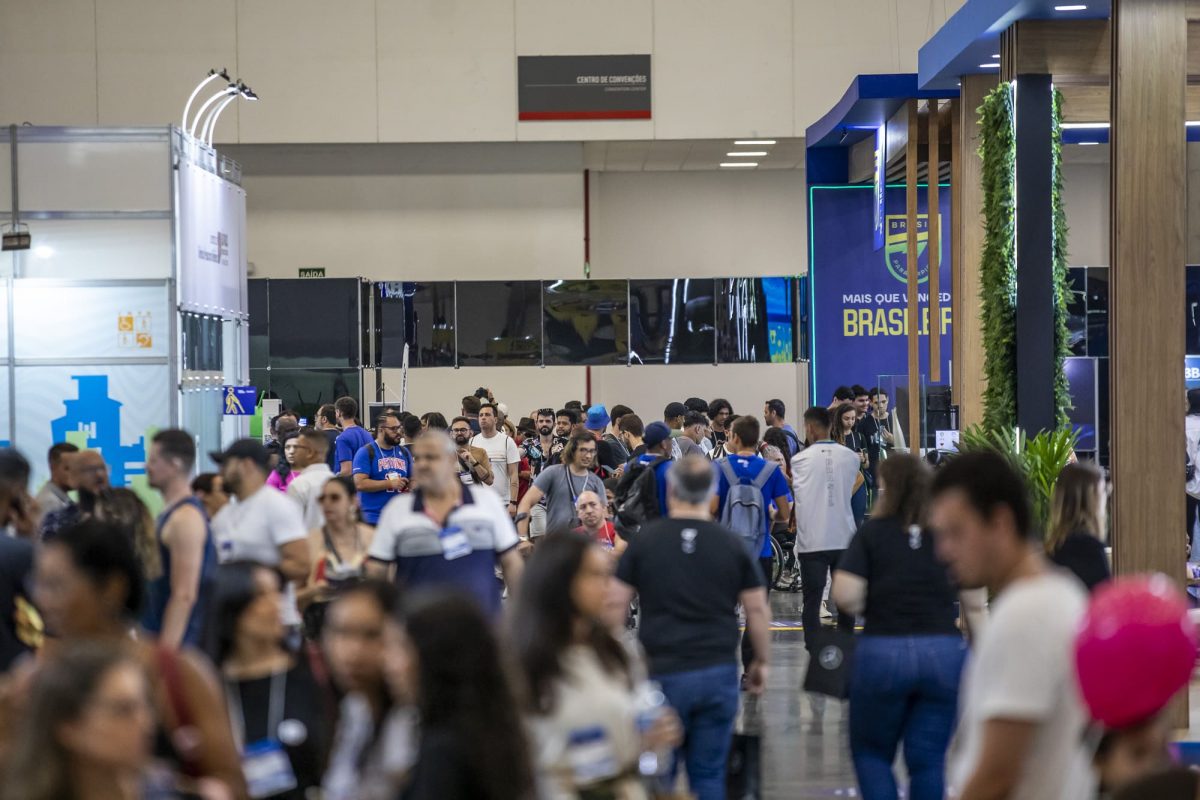
Maurício Macedo, CEO of Fiera Milano Brasil, opened the Reatech Congress this Thursday (21) alongside Marcelo Pires, CEO of Consolidar Diversidade, who is curating the event. The space at the 19th International Inclusion, Accessibility, and Rehabilitation Fair began with a plenary session on the anti-ableist struggle, highlighting accessibility as a fundamental pillar for sustainability.
Showing the two ways of interpreting ableism (discrimination and a system of oppression), Anahí Guedes, Ph.D. in Anthropology from the Federal University of Santa Catarina and a member of the Disability and Accessibility Committee of the Brazilian Anthropology Association, spoke about the ways and moments when it occurs. “There is no human being who does not lose capacities throughout their life,” Guedes states.
Next, Marinalva Cruz, diversity and inclusion analyst at Coca-Cola FEMSA and Director of Government Relations and Employability at Turma do Jiló, highlighted the ways in which ableism presents itself. “When it happens in a subjective way, not so visible, it has a greater impact. People with disabilities have various rights denied throughout the day and we, as society, are not outraged in the same way.”
Rebecka Barbosa, Chair of the Commission on the Rights of Persons with Disabilities of the OAB (Brazilian Bar Association) in São José dos Campos, explained that a culture of welfare dependency makes it difficult for people with disabilities to take on new roles. “We need to understand that a woman with a disability is 90% more likely to be trapped in a relationship, unable to leave the house. Once she understands that her body is not public property, we help her become a person who asserts her rights clearly and objectively,” said Barbosa.
Finally, digital accessibility was the highlight of the talk by Simone Freire, CEO of Espiral, founder of “Web for All,” digital accessibility expert, speaker, and a Goldman Sachs 10,000 Women alumna. “There isn’t a single person at this fair who doesn’t use technology in their daily life, from the moment they wake up until they go to sleep. But less than 3% of Brazilian websites are accessible to people with disabilities. There are nearly 20 million Brazilians with some form of disability who depend on digital solutions
Digital solutions help promote ESG and anti-ableist policies in companies
In line with the theme of the Reatech Congress, the companies' booths featured various assistive technologies—that is, resources and services that promote social inclusion by providing greater autonomy and independence for those who use them. Thus, especially in the workplace, it becomes much more feasible to speak of equity and promote a fair environment for everyone.
A Icom features a sign language service platform that connects Libras interpreters with users for free, facilitating communication between deaf and hearing people. By promoting inclusion and autonomy, the tool also contributes to ESG (environmental, social, and corporate governance) practices.
One of the missions of Google is “to organize the world's information and make it universally accessible and useful”. Participating in Reatech for the first time this year, the company operates at all stages of development to be more assertive in its products and services.
“We want to go where the user is. We noticed that many people don't know the tools we have. In total, there are more than 30. At Reatech, we brought four that serve different groups, aiming to show something interesting to everyone who comes to our booth, said Bernardo Barlach, manager of the Accessibility and External Engagement Program in Latin America.
Alexandre Soares, CEO of DS Tools, a digital solutions company, highlighted that participating in the fair, in addition to showcasing services that optimize results for the companies they serve, serves to show that they want to represent all segments of society equally.
“Our goal is to match the figures for the regions where we operate. Our company currently employs 5.7% and is aiming to reach 8%. There are 52% women in the state of São Paulo, and we already have 62% at the company. In leadership positions, that number drops to 49%, but by the end of the year we’ll already have 50%,” said Soares.
Olympic judo medalist participates in sports experience activities
At this year's Paris Paralympics, Brazil finished first in the judo medal standings, the country's best result in the sport in recent years. This is just one of the reasons that make the sport, filled with characteristics that make it naturally accessible, one of the national powerhouses, both in its traditional practice and adapted for people with disabilities.
“Today, the sport has grown a lot and you see a major search within conventional judo for people who have some type of disability for inclusion in the paralympic modality, but Brazil has been doing this work of including people with disabilities in judo for a long time, assesses Jaime Roberto Bragança, coach of the Brazilian Paralympic Judo Team.
On the second day of Reatech, the coach led a sports experience practice at the Combat Arena, located within the Brazilian Paralympic Committee's space. The objective of the activity was to offer brief practical experiences and introduce movement techniques and fundamentals of various combat sports to the fair's visitors. This Thursday (21), the highlight was judo.
The activity featured the participation of 36-year-old athlete Érika Zoaga, who debuted at the Paris Paralympics this year and has already secured a place on the podium, winning the silver medal. “Judo and I chose each other,” shares the native of Mato Grosso do Sul, recalling her 18 years of practice, which began at age 17. “Sport changes our lives for the better.”
Participating in the activity during her first visit to Reatech, Nádia Lourenço, a special education kindergarten teacher in the municipal school system of Campinas (SP), reported being “amazed by the experience.” The professional works with students with high abilities, giftedness, autism spectrum disorder, and physical and visual disabilities, and considers the opportunity to learn about the innovations presented at the fair as very timely for the advancement of inclusion and the education of people with disabilities: “The whole time we are here we are seeing technologies and resources, so it is very rich.”
“Technology must be accompanied by an appropriate physical therapy and rehabilitation process to benefit patients,” says manager of the International Institute of Neurosciences
A Reatech – International Fair for Inclusion, Accessibility and Rehabilitation, the leading event in the sector in Latin America, includes in its program the Congress of Physical Medicine and Rehabilitation (Reamed). On the second day of lectures, Edgard Morya, manager of the Edmond and Lily Safra International Institute for Neurosciences, located in Macaíba in Rio Grande do Norte, gave a lecture on the development of assistive technologies for rehabilitation.
“Currently, there are peripheral and spinal implants that act directly on nerve endings and are capable of causing functional electrical stimulation (FES) and spinal cord stimulation. This assistive technological innovation contributes to a more personalized and effective physical therapy and rehabilitation process for patient recovery. Allied to this, physical therapy professionals need to pay attention to other systems, such as the excretory, urinary, and cardiovascular systems so that the rehabilitation is done completely and not in parts,” Morya stated.
With a degree in physical therapy, Morya was involved in the project of a robotic exoskeleton for lower limbs controlled by the electrical activity of the brain, using a non-invasive brain-machine interface. The equipment was presented to the world at the opening of the 2014 World Cup in Brazil.
For him, technologies need to shape themselves to patient demands, and physical therapy professionals must be qualified to provide the best possible care. “For Brazil to achieve what we call Health 5.0, we need to align the creation and development process of the necessary technology with the treatment provided by healthcare professionals. Without this interaction, rehabilitation falls short, and technology fails to achieve its goal of giving people autonomy and quality of life,” Morya concluded.
Reatech provides the public with experiences in Paralympic sports modalities
Basketball, volleyball, and boccia were some of the adapted sports for people with disabilities that visitors to the 19th Reatech were able to try out this Thursday (21) at the Multisport Court. Instructors and athletes from organizations such as ADD (Sports Association for People with Disabilities) and IBP (Barueri Paralympic Institute) were present to guide the activities and share their experiences in sports.
Amidst the activities, Alex Sandro Pereira Nunes, 41 years old, drew attention for his friendliness and athletic skills. A street running athlete for 12 years, Alex has also practiced swimming and bocce. Over the past two years, as a member of the Achilles Brazil team, he has won 20 medals, motivated by his passion for sports. “What I like most is competing,” shares the athlete, who is also a veteran at Reatech and sees the event as an opportunity to exchange experiences and inspire new talents.
The court also attracted professionals and students interested in inclusion and rehabilitation. Reinaldo Garcia, 21, is finishing his degree in physical therapy in the coming weeks. Originally from Espírito Santo do Pinhal, in the interior of São Paulo, the student attended the event for the second time: “I come to the fair to learn about innovations (…) I think initiatives that seek to integrate people with disabilities into the most diverse environments are very important.”.
Marcello Oliveira, 24, participated in the event for the first time. Originally from Taipu, Rio Grande do Norte, the occupational therapy student from PUC Campinas took advantage of the trip organized by his university and arrived at Reatech with the goal of exploring new approaches for caring for people with motor disabilities.
In addition to basketball, volleyball, and bocce activities, the Reatech Multisport Court offered trials in sports such as track and field and goal kicking, providing visitors with a direct understanding of the impact of these practices on the inclusion and well-being of people with disabilities.
Volunteers offer reception to visitors at Reatech
In all its editions, Reatech features the participation of a team of volunteers of excellence. They are students, professionals from various fields, and retirees who dedicate themselves to helping visitors at the fair. With a diverse team, including individuals with knowledge in Brazilian Sign Language (Libras) and the memorable red vest, the 275 volunteers are always ready to offer assistance when needed. The priority is to ensure inclusion and accessibility, accompanying and supporting those who need it most.
To provide quality service, volunteers receive basic training, learning, for example, how to guide a person with a visual impairment or assist wheelchair users and people with reduced mobility. This preparation is essential to ensure inclusive care during the four days of the event.
“Our team of volunteers is made up of people with different backgrounds, all with the desire to participate, help, and share experiences. This environment fosters new relationships and enriches both those who receive support and those who offer it. For many, volunteering here becomes a true school, contributing to their personal and professional development. It is like a practical internship, especially for those who are studying. But that is not all: we also have volunteers who have no connection to universities, but participate simply because they enjoy it and find pleasure in helping,” highlights Suely Yanez, Reatech's volunteer coordinator.
Among the volunteers, there are newcomers and veterans, such as Ivanir Rodrigues (65), who is participating as a volunteer in the event for the third time. For her, the visitors“ happiness and the opportunity to help others are the main motivations for returning every year. ”I think people should look to Reatech as a reference, because anyone who comes here for the first time never forgets it. Seeing so many people who, even with their limitations, remain happy and active is something contagious. It inspires us and teaches us to have more empathy for others," states the veteran.
Suely shares that volunteering always starts with a lot of joy! “We are the gateway to welcoming people who arrive, especially those with visual impairments, reduced mobility, or who need assistance in some way. Our role is to welcome everyone with a smile, a hug, and all the positive energy we can offer.”.
This joy also infected Beatriz Waimberg (18), an Occupational Therapy student, who decided to participate as a volunteer, even though she had initially planned to attend the fair only as a visitor. “As soon as I learned about the possibility of volunteering, I was sure it was the right choice. Having a fair like Reatech is essential, both in the human and social aspects, because it shows the importance of accessible resources to promote inclusion and accessibility. Here, people find what they need,” Beatriz emphasizes. The young woman also stresses that her motivation goes beyond academic obligations. “We came here much more to contribute to the fair, because it is such a beautiful event, than out of a study requirement. I will definitely return in future editions,” she concludes.
Companies offer job openings for people with disabilities
The exhibiting companies at the 19th Reatech, Latin America's premier inclusion, accessibility, and rehabilitation trade show, used the event to advertise courses and job openings for people with disabilities. A specific area was created for this purpose, the Arena Empregar.
The project aims to promote the professional inclusion of people with disabilities and individuals undergoing rehabilitation, connecting them directly with companies and institutions that offer inclusion opportunities in the labor market, with the participation of corporate companies, recruiters, social organizations, experts, and the general public.
One of the exhibitors with course opportunities and job openings is SENAC. In addition to job openings for apprentices and general competition, which include people with disabilities, the educational institution presents the Trampoline Work Education Program, an exclusive initiative for people with intellectual disabilities.
“All our regular programming is open to people with disabilities. Therefore, we do not make distinctions regarding the courses. Upon receiving an interested applicant, we seek to make the necessary adaptations to accommodate that student, depending on the area they choose. Regarding the Trampolim project, we saw the need to create something exclusively for people with intellectual disabilities, since we understand that this audience faces a greater difficulty in entering the job market, states Andreza Matsumoto, coordinator of the SENAC Inclusion and Diversity Program.
“At Trampolim, we work on skills so that people with intellectual disabilities can adapt to the world of work in general, so we prioritize that they have good communication, are able to have autonomy, and can self-regulate within a more formal environment, she adds.
Visitors interested in learning about the courses and job openings at the institution can go to the booth to find out more details. In addition to SENAC, Carrefour, Atacadão, Assaí, Santander among other exhibiting companies, there are open positions for people with disabilities in operational and administrative sectors.
Service:
Reatech Brasil + Expo Brasil Paralímpico 2024
International Exhibition on Inclusion, Accessibility and Rehabilitation
Dates: November 20 to 23
Hours: 10 AM to 7 PM
Location: São Paulo Expo
Address: Rodovia dos Imigrantes, 1.5 km – Vila Água Funda, São Paulo – SP
More information in this link.
Photos from the 2024 edition Access here
About Fiera Milano Brasil
Fiera Milano Brasil it is Brazilian subsidiary of Fiera Milano, one of the world's largest trade fair and congress players, which each year attracts approximately 30,000 exhibitors and more than five million visitors. In Brazil, there are ten fairs that represent the most diverse segments of the economy, such as security, clean and renewable energies, pipes and fittings, cables, occupational health, rehabilitation technologies, inclusion and accessibility, among others. Among the main brands in the portfolio are Exposec, FISP, Fire Show, Ecoenergy Congress, Tubotech, wire Brasil, Fruit Attraction São Paulo, in partnership with IFEMA Madrid, Reatech + Expo Brasil Paralímpico, in partnership with the Brazilian Paralympic Committee (CPB), Esquadria Show, in partnership with NürnbergMesse Brasil, TranspoQuip, and ExpoParking in partnership with BMComm. More information: www.fieramilanobrasil.com.br
Press Information:
2PRÓ Comunicação – Fiera Milano Brasil
Myrian Vallone | Teresa Silva – 11-99228-7836
e-mail: fieramilano@2pro.com.br
(11) 3030-9463 | 9404