
By Patrick Schneider, Talent Management Manager at FMC
If we consider that 51% of Brazil’s female population and about 56% identify as Black or mixed-race, yet we do not see this reality reflected within organizations, we realize that there is an urgent need to discuss the advancement and access of a very large group of Brazilians.
And there is a need for us to understand that Diversity, Inclusion, and Equity are not a fad, not a passing conversation, not a trend; it is something deeper and with the potential for great social transformation.
Despite having ethnic-racial affirmative action policies to address access to higher education, established 10 years ago, and policies for access to employment for People with Disabilities, created over 30 years ago—and while these laws have driven important opportunities for these groups—in my reflection as a human resources professional, I understand that we still have much to do to achieve greater representation of these groups in corporations, broadly and across all levels of the hierarchy.
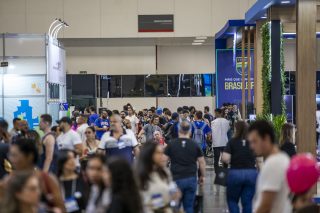
In the debate I participated in during the 17th ReaTech – Congress on Inclusion and Accessibility in the Labor Market -, held in September in the capital of São Paulo, I had the opportunity to share aspirations and necessary reflections on these issues with colleagues from other companies in the most diverse fields, ranging from technology developers, software, and logistics companies to agribusiness. The conversations discussed the realities faced inside and outside companies, taking an expanded view of society, and alternatives in pursuit of broad representation within the corporate environment.
The currently perceived organizational behavior points to the opening of job openings directed at different social markers; for example, this position is intended for Black people, this position is for women, this position is specifically for people with disabilities.
This is an important intentional behavior that demonstrates a movement in search of change. However, after people enter organizations, career progression proves to be slow, or in many cases, is something that is not perceived.
When looking at the top of organizations, the dominant composition remains mostly white men, of a similar age group, who practice identical organizational rites.
This reality was identified in a study conducted by the Brazilian Institute of Corporate Governance —IBGC—this year, which surveyed 337 companies; of these, 78.9% had women on their boards and executive teams, but none had at least 50% women on their staff.
So, a major market challenge lies in the “E” for equity. This research points out one of the dangers of the debate surrounding the topic: the singular presence of diversity.
As if the fact that there is a Black person, or a woman, within a leadership group were enough for prejudice to be eradicated from that culture.
In agribusiness, for example, one of the major challenges is precisely this point: expanding the female presence in the production chain.
With that in mind, I had the opportunity to share at the event some of the equity acceleration plans that have been underway for some time at FMC, an agricultural sciences company, including the goal of increasing the global female workforce by 50%.
We are aware that we must go even further, and to this end, there are designed programs that are not just talk and whose objective is to support talent through purposeful careers and promote the visibility of women, racial and ethnic groups, LGBTQIAP+ communities, and new generations, with the approach of connecting and empowering employees to have a voice and cultivate leadership within FMC.
The presence of women in agribusiness, in prominent and decision-making positions, has been a movement driven by the succession process in the countryside. I perceive a behavioral shift, driven by the digitalization and hyper-professionalization of the segment at all levels.
The establishment of dialogues with all the diversity present in the field will take place through the equally diverse presence within the companies part of the agricultural supply chain.
I brought to the debate the importance of Talent Review, where the central focus is to give visibility to the potential of professionals, and raise Intentionality, so that we can have more actions that truly collaborate towards a more inclusive environment, I notice that the number of organizations that look at this approach is still low.
What hinders the acceleration of Equity, in my view one of the greatest challenges to be faced by the world of work.
During ReaTech, several other projects and ideas were brought to the table for debate and, in my view, what remains from this experience is the realization that only corporations with a forward-looking vision—one that ensures diversity, inclusion, and equity are represented not merely in their environments to comply with the quota law, but are truly promoted, going beyond and effectively providing opportunities for presence in all spheres of the company—will manage to serve a broader market.
And it is up to the leaders who are currently handling these issues within corporations to promote, with great dedication and responsibility, the implementation of policies that change the statistical figures we have on hand today, so that in a future meeting we can indeed consistently have advanced beyond expectations.
Patrick Schneider – LATAM Human Resources Manager at FMC, with 20 years of experience in global companies, dedicated to research on the Future of Work, Decent Work, and Social Inclusion Through the Labor Market.
He has a degree in Law, with specializations in Labor Relations, Strategic Leadership in Business and People, and Design Thinking, in addition to holding an MBA in Business Management from Fundação Getúlio Vargas (FGV), a master's degree in Sustainability from PUC Campinas, and an executive certification in Leading the Future of Work from MIT.
He is the author of the book “Future of Work for People with Disabilities: From the Quota Law to the 2030 Agenda” (Futuro do Trabalho da Pessoa com Deficiência: da Lei de Cotas à Agenda 2030), published in 2021 by Letramento, and co-author of “Essays for a Conscious Organization” (Ensaios por uma Organização Consciente), published in 2022 by Jandaíra. He has publications in magazines and scientific journals on the themes of the inclusion of people with disabilities through the labor market and decent work..
About FMC
FMC Corporation is a global agricultural sciences company dedicated to helping growers produce food, feed, fiber and biofuel for a growing world population while adapting to a changing environment.
FMC's innovative crop protection and nutrition solutions, such as biologicals, precision agriculture, and digital farming, empower farmers, agricultural consultants, and professionals to face their greatest challenges in pest and disease management while protecting the environment.
With approximately 6,400 employees in more than 100 locations around the world, FMC is committed to discovering new active ingredients for herbicides, insecticides, fungicides, new formulations of chemical and biological products, and pioneering technologies that are better for the planet.
About the event
17th Reatech – International Fair of Technologies for Rehabilitation, Inclusion and Accessibility
Data: from September 1st to 4th, 2022
Time: from 1:00 PM to 8:00 PM on the 1st and 2nd; from 10:00 AM to 7:00 PM on the 3rd and 4th
Local São Paulo Expo
Address: Imigrantes Highway, km 1.5 – Vila Água Funda – São Paulo – SP
More information and programming are available at site of the event.
About Fiera Milano Brasil
Fiera Milano Brasil, the Brazilian subsidiary of Fiera Milano—one of the world's largest trade fair and congress organizers, which each year attracts approximately 30,000 exhibitors and over five million visitors—became the majority shareholder of Cipa do Brasil in 2011, giving rise to Cipa Fiera Milano, and as of 2022, to Fiera Milano Brasil. In Brazil, nine trade fairs are held representing the most diverse segments of the economy, such as security, clean and renewable energy, pipes and fittings, cables, occupational health, surface treatments, window frames, rehabilitation technologies, inclusion and accessibility, among others. Among the main brands in the portfolio are Exposec, Fisp, Fire Show, Fesqua, Ecoenergy, Reatech, and Ebrats.
Press Information
2PRÓ Comunicação
Myrian Vallone | Teresa Silva | Renê Gardim
Team email: fieramilano@2pro.com.br
(11) 3030-9463 | 3030-9404 | 99228-7836
SOURCE: