| A Reatech Brazil it is coming and it is time to discover what is most innovative in the market. Latin America's largest Rehabilitation, Inclusion, and Accessibility Technologies Trade Show takes place in São Paulo (SP), from October 4 to 7, and is the stage chosen by Colibri Interfaces to present its new creation to the world: the Conversia communicator device.
“Imagine a person who has lost their voice and neck-down movement communicating again through any residual movements, not just of the head, but also of any part of the face. Conversia transforms gestures such as opening and closing the mouth, smiling, pouting, blinking, among several others, into phrases completed quickly via advanced artificial intelligence and vocalized by the equipment with a synthesized voice that can even imitate the timbre the person once had. Imagine the impact of this Brazilian technology for the millions of people around the world who are currently in this condition, explains Adriano Assis, CEO of Colibri.
How does it work?
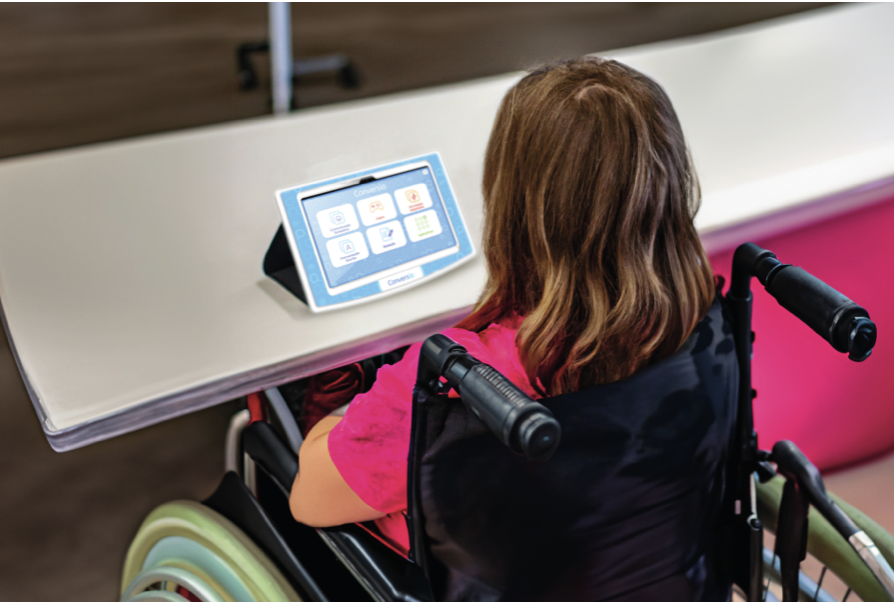
As the second product in the portfolio of the startup Colibri from Minas Gerais, Conversia is a type of tablet that combines all alternative interaction and communication technologies into a single device.
Through facial recognition, captured in real time by the equipment's camera, it is possible to communicate in writing or using symbolic cards, using any combination of voluntary facial movements, such as smiles, opening the mouth, and blinking, in addition to horizontal, vertical, and lateral head turns, or even direct hand touches on the device's screen, even if the person has low fine motor coordination. The device quickly adapts to each individual and converts these gestures into vocalized phrases, text writing, app navigation, and even game control.
It is also possible to use Conversia to control smart devices, such as Smart TVs, light bulbs, and smart plugs, use applications accessibly, and even control other devices such as computers and cell phones, always utilizing the repertoire of voluntary movements that each person is capable of performing with low effort.
The device features advanced artificial intelligence to speed up the prediction of written phrases and for the automatic creation and suggestion of alternative communication cards based on the user's own vocabulary. It was designed to assist people with Amyotrophic Lateral Sclerosis, stroke sequelae, cerebral palsy, Spinal Muscular Atrophy, muscle injury, as well as conditions such as non-verbal autism and other situations that compromise speech, such as tracheostomies.
Elaine Luzia dos Santos, 34, the first student in Brazil to graduate in medicine after losing her speech, arm movements, and ability to walk, is also one of the first people to test the new technology. Today, she still communicates with the people around her using a rudimentary letter board, manually navigated by a communication partner. “Thank you very much for thinking of me and of people who are in need,” she wrote after being invited to try the system.
From Brazil to the world
After Reatech, Adriano Assis and the Colibri team head to California (USA), where they will represent Brazil in the final of the Startup World Cup (SWC) in November. The SWC is a global competition that recognizes the best startups from around the world.
The annual competition is divided into regional stages, held in each country, and a global stage, where startups have the opportunity to present their projects to an audience of experts, in addition to competing against each other for the final prize, a 1 million dollar investment. |