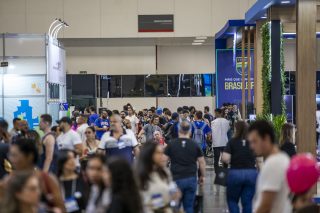
São Paulo, June 2019– Black stove, white countertop. The color contrast makes all the difference. It might seem like an irrelevant detail, but for those with low vision, it is a crucial detail for a safe and independent routine. Casa Conceito is at Reatech- International Fair of Rehabilitation, Inclusion and Accessibility Technologies proposing this experience to visitors.
Project creator and architect Gabriella Zubelli showcases an adapted four-room house featuring various accessibility lines at the Direct Borrachas booth. It includes modular cabinets, correct furniture heights, clothing with Braille information, and accessories that make it easier to identify fabrics. The idea is to provide an environment where all visitors can experience the daily routine of people with disabilities. “Our proposal is to make people who do not need adapted spaces feel how important it is to think about these details. Adapted homes are good for everyone,” explains the architect.
Sitting in a wheelchair for the first time and experiencing the space from a new perspective. You cannot grab an item that a person needs if it is too high. You cannot open a cabinet door if it is too low. “Small details that we only notice when we put ourselves in someone else's shoes,” says Zubelli. With this purpose of provoking the public, many leave Casa Conceito more sensitized; it becomes more evident that a lot of progress is needed for the democratization of access.
If the visitor wants to immerse themselves even further in the subject, the blindfold shows that touch is more important than we are used to. A simple organization in the closet can give more autonomy to those who cannot see. Just explore textures and put braille labels wherever needed.
Guided tours at Casa Conceito are open to all visitors at the Direct Borrachas booth, from 1 PM to 8 PM. The tours are accompanied by specialized professionals from each area and accessibility products.
Father's inventions improve son's well-being and give rise to a startup
Marcelo Pirk is an architect by training, but has worked with computer graphics and developed applications since 2010. The birth of his son 12 years ago, however, shifted his focus somewhat. Because his son was born with myelomeningocele—a congenital malformation of the spine—Pirk began working on solutions to improve his well-being. It went so well that two of these solutions won awards, and one of them gave rise to a startup.
Pirk was at Reatech – International Fair of Technologies in Rehabilitation, Inclusion and Accessibility this Friday (14) to talk about his inventions and his startup, which does not yet have a defined name. His main product, however, is already certain: a mobile biofeedback. It is a sensor that captures any muscle effort, translates it into numbers, and sends it via Bluetooth to a mobile app.
“That is hardly new. The tool I developed, however, collects data from a game – similar to Flappy Bird. As the user plays, more data is generated and transformed into reports. With these reports, it is possible to measure physical therapy progress, he says.
As can be seen, this solution transforms a monotonous, tedious task into something playful and fun, which is important for attracting and maintaining the little ones' attention. The idea now is to expand the project so that it caters to other types of conditions – and also to increase the number of compatible games.
It is worth mentioning two other past projects by Pirk: p-plot, an app that made it easier to monitor his son's urination, and a custom exo-orthosis, the model of which was manufactured on a 3D printer and which put an end to the sores that appeared every two weeks on the boy's foot.
Far beyond quotas: companies want to help people with disabilities get jobs in their fields of expertise
Nearly 60% of people with disabilities who left their last job cited a lack of career prospects as one of the main factors behind their decision. The second most frequently cited factor was “feeling like just a quota hire,” with 52%.
This data is from a survey conducted by i.Social, in partnership with the Brazilian Association of Human Resources and Catho, an online job and resume classifieds company. Catho, for the first time an exhibitor at Reatech – International Fair of Technologies in Rehabilitation, Inclusion and Accessibility, wants to change this scenario.
“We want genuine inclusion, so that people with disabilities can re-enter the job market doing what they know and love to do, not just to comply with a law,” said Maiara Tortorette, the company's marketing coordinator, on Thursday (15). “Since 2016, the website has been free for people with disabilities covered by the Quota Law. Our idea in coming to Reatech is to spread this information to professionals, register them on the website, and help them, through guidance, to get a job,”,
Agora, also present at Reatech, follows the same approach. Operating in 14 Latin American countries, it is a professional inclusion and qualification program aimed at people with visual impairments (the blind and low vision). During the trade fair, in addition to guiding and registering people looking for job opportunities, it will seek to establish partnerships with employer companies.
Freedom of movement
"To make wheelchair users the protagonists of their own lives." This was the goal of Júlio Oliveto, a Ph.D. in Mechanical Engineering, when he created Livre Soluções, a company that produces the Kit Livre, which provides greater freedom for wheelchair users. “We wanted to create a solution capable of increasing the freedom of people who depend on wheelchairs for their mobility.”.
The system, which is on display at Reatech 2019, consists of adding motorcycle handlebars with an electric motor, ranging from 350 watts to 1,500 watts. “The intention was to have a more youthful look at the mobility solution for wheelchair users,” says Oliveto.
The company emerged five years ago from the engineer's master's degree final project. “We tried to find a company to license the patent, but we didn't find any interested parties. So we decided to set up our own manufacturer,” Oliveto explains. “I was even called crazy for betting on the model, but today we are already consolidated,” he guarantees.
In addition to kits designed for urban riding, Livre also offers what it calls the Flex Kit, intended for off-road use or hand bikes. With prices starting at R$ 4,000, the Livre Kit can cost up to R$ 12,000.
Technology helps in the development of cognitive abilities
Cognitive capacity is under-explored and can represent a major breakthrough in the performance of both high-performance athletes and the average citizen. The statement was made by Milton Ávila, Ph.D. in Neuroscience and CEO of Sensorial Sport, who spoke about “Monitoring and development of cognitive capacities: how to support a post-injury and recovering athlete?” during Reasem – Rehabilitation and Inclusion Technologies Seminar, which takes place at Reatech 2019.
“We use our senses to obtain information about the world around us, and also about our own body, that is, our proprioceptionability to recognize the spatial location of the body, its position and orientation, the force exerted by the muscles, and the position of each part of the body in relation to the others. In most situations, the brain Humans use visual information to guide choices. This means that we base many of our decisions in what we see,” explains Ávila
Using technology, especially virtual reality glasses, Ávila says that Sensorial Sports is capable of monitoring and training cognitive abilities. “Thus, we can create filters that interest us to ensure that a person’s attention does not stray from their goal, which maintains focus and ensures greater performance.”.
In a second phase, a touch screen is used to develop the brain's responsiveness to commands. If our senses (especially vision) are so important for our decisions, how to improve the way we perceive the environment?, question Ávila.“There are some tools that place demands on our brain and, consequently, they train our cognition.And that's what we do.
The great advantage, according to Ávila, is that “by keeping cognitive work active, it is also possible to improve living conditions while physical limitations exist.”.
Alternative communication and assistive technologies for people with disabilities
Rafael is a child with intellectual and motor disabilities, and with serious limitations in communicating. To overcome them, he uses various tools and technologies. At Reatech – International Fair of Technologies in Rehabilitation, Inclusion and Accessibility, he had an iPad with him, and thus helped psychopedagogue Liana Santos, whose patient he is, with her lecture.
Liana's lecture took place this Friday (the 14th) at the Tecfisio space, which hosts seminars on advanced technologies in physical therapy. As a special education expert, she spoke about how psychomotricity—that is, the integration of motor and psychological functions—combined with assistive technologies, can help with the communication challenges that many people face.
“This alternative communication, and the teaching of it, has to be at the service of daily life, so that the child, for example, can go to school and parents can communicate with their children,” she stated.
Liana touched upon several subjects and detailed a series of concepts. In short, she emphasized that since communication does not depend solely on oral or written language, as it also encompasses signs, gestures, and expressions, people with disabilities can use these resources to understand and make themselves understood.
In these cases, technology serves as an ally. Rafael, laughing and smiling with his iPad, demonstrated how true this is.
Service:
16th Reatech 2019
DataJune 13 to 16
Schedules:
Days 13 and 14, from 1 PM to 8 PM,
Days 15 and 16, from 10 AM to 7 PM
LocalSão Paulo Expo Exhibition & Convention Center
https://reatechbrasil.com.br.alluring-pink-stork.72-61-35-14.cpanel.site/
About Cipa Fiera Milano
Cipa Fiera Milano, the Brazilian subsidiary of Fiera Milano—one of the largest trade fair and congress players in the world, which each year attracts approximately 30,000 exhibitors and more than five million visitors—became the majority shareholder of Cipa do Brasil in 2011, giving rise to Cipa Fiera Milano. In Brazil, it organizes nine trade fairs representing the most diverse segments of the economy, such as security, clean and sustainable energy, pipes and fittings, cables and wires, occupational health, surface treatment, window frames, rehabilitation technologies, inclusion, and accessibility, among others. Among the main brands in its portfolio are Exposec, Fisp, Fesqua, Ebrats, Ecoenergy, and Reatech.
Press info:
2PRÓ Comunicação
Team email: fieramilano@2pro.com.br
Teresa Silva – (11) 3030-9463 / 99228-7836
Renê Gardim – (11) 3030-9422
Fádia Calandrini – (11) 3030-9402 / 21-98221-7401
Ricardo Berezin – (11) 3030-9463
Myrian Vallone – (11) 3030-9404
www.2pro.com.br