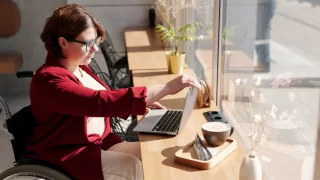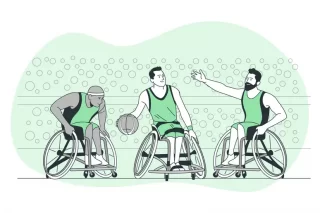
Digital influencers with some kind of physical disability have been fighting prejudice with humor and information. Videos that expose daily problems faced by people with disabilities and that talk about recognition and empowerment are winning thousands of followers in Brazil. We spoke with four names who are national references on social media to talk about equality and how to avoid the culture of ableism.
What is ableism?
Ableism is a term used to characterize prejudice against people with disabilities. The word comes from English ableism, which means, in literal translation, “capacity”. In practice, an ableist person discriminates against people with physical, sensory, and intellectual characteristics that deviate from what they consider a “normal standard” of society. This prejudice can be apparent, but it can also be veiled.
The legislation already considers ableism a crime. Established in 2016, the Brazilian Inclusion Law defines, in Article 4, that “every person with a disability has the right to equal opportunities with other people and shall not suffer any kind of discrimination.” Thus, an ableist person can be arrested or pay a fine for this prejudice.
Humor as an ally
Wearing a T-shirt that read “Deficiente é o seu preconceito!” (Your prejudice is what's disabled!), the digital influencer Ivan Baron, 22 years old, told State of Minas a bit of his journey on the internet. “This word influencer is a lot of responsibility, but I decided to occupy this space because I had a need to pass on information, new concepts about people with disabilities that other influencers weren't passing on”.
Ivan has over 43 thousand followers on Instagram and 122.8 thousand on TikTok. In addition, the influencer from Rio Grande do Norte has a degree in law and gives lectures on ableism.
Baron said that he was a very private person before public life and that he was afraid of people's reactions. “I was a very shy person who was afraid of exposing myself, afraid of people judging me for being different, for thinking outside the box. So, I always kept what I thought to myself. Until one day I decided to expose myself and realized that there were other people who thought like me.”
I see a lot of people arguing about racism, LGBTQIphobia, feminism, and these are very important issues, but what about ableism, where is it? So why not occupy this space as well?
Ivan Baron, digital influencer
On his social media, Ivan doesn't limit himself to talking only about his own disabilities. “I always try to listen to other people with other disabilities to speak to people without disabilities,” he commented. Thus, the influencer jokes that his work “is an individual project with collaborators.”.
To break so many paradigms, Ivan uses creativity in his videos and comments that this has become a major differentiator when conveying his message. Thus, humor has become a great ally. “Why not convey information in a light and entertaining way? Humor, I believe, is one of the best ways to do that.”.
According to the young man, “just because it's comedy doesn't mean we can't make our social criticisms.” “On the contrary, it's all the more reason to responsibly convey what we believe in. And I've been noticing that people are loving it,” he stated.
The influencer comments that it is possible to have a less ableist and more inclusive society, but that he needs help in this achievement. “Brands need to understand that people with disabilities are able to influence other people,” he commented.
The future is accessible, but the present has to be inclusive
Ivan Baron, digital influencer
Multi-talented
Working with the internet came naturally to the digital influencer Juliana Santos. She says that she started it to promote her work as a fashion designer. Gradually, Juliana developed two online projects.
“When I started creating, I made clothes for myself. Then, I started posting pictures on Orkut and my friends liked them. I created a blog to show my looks and became a fashion blogger. Instagram started small. I only made customized shorts and, later, wedding dresses. Because of that, social media boomed and my personal life became just as interesting as my work as a designer, she commented.
Juliana separated projects into two profiles. “First, there was a picture of my daughter eating baby food and then two brides getting married. So, I had to separate them and make two Instagrams: the atelier profile, which has a lot of engagement, and my personal one, where I talk about what I like, what I believe in, and what I stand for,” she explained.
Santos says that he always tries to teach something, even as a joke. “I think that when we start explaining and telling people that what they do is wrong, but not in an aggressive way or wanting to be a social justice warrior, it makes the person reflect and not want me to be in that situation,” he stated.
Juliana said that many people with “normal” bodies thank her for helping them break this prejudice. “I've seen people saying that they were ableist and didn't know it. I've seen others saying that they learned to hire people with disabilities and others sharing that they stopped seeing people with disabilities as just an example of overcoming adversity,” she commented.
Juliana explains that comedy is a way to “address more serious subjects.” But she says that this strategy began in a different way within her work. “I started posting the funniest videos on TikTok and reposting them on Instagram. So, my content started to become very mixed. People no longer want to see that Disney princess life.” But Juliana explains that the goal is not to attract the audience just through laughter. “I don't want to be the clown in the circus without a hand. If you follow me only for the comedy and not for who I am, maybe you are following me for the wrong reason,” she stated.
Making History
Cacai Bauer has been making history as the first digital influencer with Down syndrome. At 26, the model has already gained more than 118 thousand followers. Cacai's online journey began in 2016, when she created a YouTube channel. “My sister, Luiza, really wanted to create a cover channel and ended up giving up. I took advantage of her enthusiasm and created my own channel. Before that, I was already posting my theater performances and some home videos,” she shared.
Cacai said that she didn't see other people with disabilities working as influencers when she started her career. “We did several searches on the internet and didn't find anyone who did the work I was developing. A website I gave an interview to also did the same search and didn't find anyone.”
For the model, the way content is produced influences public reception. According to her, information is better absorbed through comedy. “I always try to make my content in a light and fun way,” she explained.
The productions for social media of Cacai involve the entire Bauer family. “My team is my family. My mother takes care of production, my sister does the recordings, photos, and edits, my brother acts with me, and my father is my press officer and handles my media kit,” she commented.
Despite the challenges at the start of her career, today the model is very hopeful about the future of digital influencers with disabilities. “They must go to work in the mainstream media.”
It is not a sad life
“So, it's not a life of suffering. I can talk about various subjects,” stated the digital influencer from Minas Gerais Stephanie Marques. Since 2019, Stephanie has been growing on Instagram with content related to the female universe.
Despite having a career of over a year, she shared that it was only at the beginning of this year that she started talking about her disability. “Since I am a person with a disability, I decided to open up more about this topic on my profile.” The native of Minas Gerais has over 5,000 followers on Instagram and continues to expand her presence on the platform.
With this attitude of talking about her disability, Stephanie noticed how she manages to reach society. “I think my content shows representation. In my case, with dwarfism, it shows I live life in an extremely normal way, just like anyone else should,” she explained.
“I am not an example of overcoming adversity, nor am I a warrior. I am just a short-stature adult woman living my life. People have this initial perception that a person with a disability is a pitiable and suffering person. And when they look at my content and everything I show and represent, that view changes.”
The influencer adds that her taste in fashion also helped break down this prejudice. “I have a conscious fashion consumption and my style is very minimalist, so people also identify with this vision. And I know this also breaks down prejudices because I convey these ideas in a very calm way. So it's not a suffering life, I'm able to talk about various subjects.”