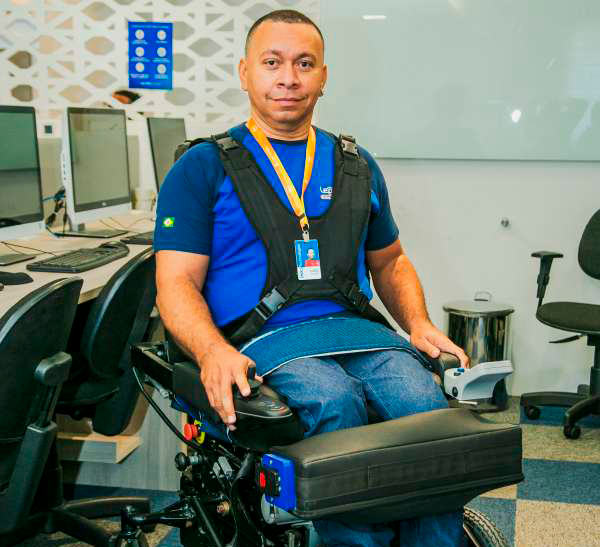
A device capable of putting a wheelchair user in an upright position, enabling the inclusion of People with Disabilities (PwD) in jobs and roles in the industry or other sectors that were previously occupied only by able-bodied workers. This is the unprecedented Steve exoskeleton, created through a partnership between the State University of Ceará (Uece), via the Development and Innovation Laboratory (LDI), and Dell Technologies, via the Research, Development and Innovation Center (Lead).
According to the chief scientist of LDI/Uece and creator of the exoskeleton, Professor Francisco Carlos Oliveira, Steve is “a device to enable work.” The Uece professor says that the idea arose from the constant search for partnerships to promote more inclusion and accessibility for Brazilians with disabilities and from observing Dell's production line:
“I looked at that place and saw that everything is set up, everything is designed for productivity. People work standing up, all at the same height, because there is a conveyor belt that moves from station to station. So, when I saw that, I imagined the possibility of people in wheelchairs also being able to work at a computer assembly station, since they usually work in other roles that are less valued economically,” explained Professor Fran, as he is known.
Steve is an unprecedented product worldwide, which is already certified by Anvisa and Inmetro. “There are other exoskeletons that work on other aspects, but ours is unprecedented because it is the first one that enables people for work,” also contributing to compliance with the Quota Law, points out the creator.
Uece's rector, Professor Hidelbrando Soares, points out that the research at the institution that enabled the development of Steve brings together two very important agendas for the University: “scientific and technological innovation and accessibility. Focusing on these agendas, the partnership between Uece and Dell, through the Informatics Law, has turned strongly toward the development of assistive technologies, consolidating us as a scientific reference in this area. As a result of this successful partnership as well, the technology presented by Dell carries a Uece DNA, and the outcome is the strengthening of science, technology, and accessibility actions.
According to Eder Soares, Innovation Project Manager and Lead leader in Fortaleza-CE, “the creation of Steve is part of Dell’s investments to create an environment that is favorable to the attraction, inclusion, and integration of people with disabilities,” adds the representative of the partner company of Uece.
Steve's research and production project began in 2018 and involved a multi-professional team to create equipment that would not interfere with the worker's health, as the manager points out. “The challenge in creating the exoskeleton involved not only the ultimate goal of enabling people with disabilities to work at the Dell factory, but also a series of precautions and research aimed at generating a positive impact on employee health.”.
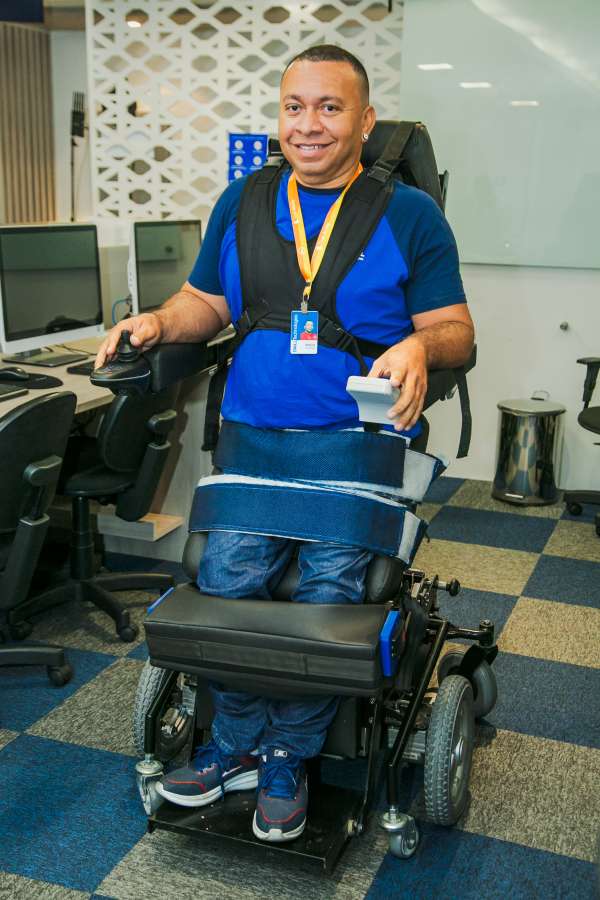
Thus, the exoskeleton features ergonomic seats, knee, arm, and calf supports, and even blood circulation support. In addition, it has several safety devices, such as an emergency button, chest and leg straps, anti-fall devices, and a fixed rear support. “We are delivering a safe and reliable solution for our employees,” assures Eder.
In an interview with Exame magazine, Dell software tester Erico Oliveira highlighted: “I have my life, I use a wheelchair, at home I can use crutches too, but with Steve it is different because with crutches I cannot let go of my hands. With Steve, on the other hand, I am free of crutches and a wheelchair, not needing to lean on anything, grabbing something from the cabinet leaves me quite free, without asking for help.”.
Steve is part of an accessibility project implemented by Lead at the Dell factory in Hortolândia, SP, which currently employs 94 professionals with disabilities on the production line. With Steve, this number could grow, as the next steps are already being planned, which, according to the Dell representative, will be the implementation of the project at the aforementioned factory in the coming months.
Source: ceara.gov