
- Almost 800 thousand Brazilian children live with uncorrected eye problems; research estimates that a child with poor vision learns approximately half as much as a child with good or corrected vision;
- In total, Brazilian children could gain the equivalent of nearly 300,000 years of schooling if simple vision problems were corrected;
- The potential economic contributions these children would make to the Brazilian economy total R$ 21.9 billion annually—the third-highest among all countries.
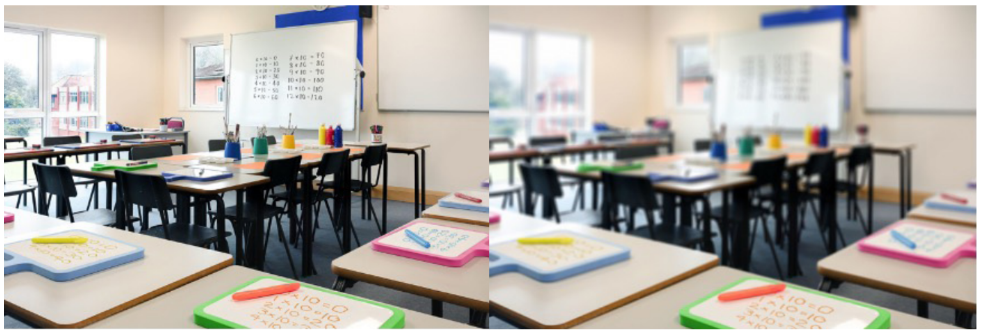
On every school day, 800,000 Brazilian children go to school with uncorrected vision problems. Children with refractive errors—such as nearsightedness, farsightedness, or astigmatism—cannot see chalkboards and books, and unprecedented research has estimated for the first time the learning losses associated with these problems.
O study, launched by the International Agency for the Prevention of Blindness (IAPB) and the Seva Foundation on the occasion of World Sight Day, celebrated this October 10th, shows that a child with impaired vision learns approximately half as much as a child with good or corrected vision.
This loss of learning directly affects an individual’s lifetime earnings and, consequently, the Brazilian economy. For example: if a five-year-old child receives glasses at the start of school and continues to wear them until age 18, their lifetime income will be, on average, 78.1% higher than if they had never had their vision corrected—in nominal terms, their earnings would be up to R$ 296,500.
The new study shows that if all children with vision problems had access to glasses, Brazil would gain nearly 300,000 years of schooling each year, which would represent a future increase of nearly R$ 21.9 billion for the country’s economy. This figure is the third highest among all countries.
“With this first global estimate of the real learning losses associated with poor vision, we see how much our children could benefit from receiving glasses when needed. In Brazil, which consistently ranks at the bottom of education indicators compared to other countries, it is important to ensure that poor vision is not preventing any child from learning and thriving,” says Caio Abujamra, President of the Suel Abujamra Institute.
Dhavi Pietro da Silva, 12 years old, born in Campina Grande, Paraíba, experienced an improvement in his learning after having his vision corrected. He has astigmatism, but did not have the financial resources needed to buy the glasses he required. Last year, he took the opportunity to write a letter to Santa Claus asking for an eye exam and prescription glasses.
 |
Studying without glasses was very bad. First, I sat in the back of the classroom and had to move to the front rows to see the chalkboard. But even so, I saw things blurred, my vision would darken, everything was very difficult, Dhavi reports. |
Most of the time, refractive vision errors are not corrected simply because they have not been identified—many students do not have easy access to eye exams or are not aware of the importance of having an eye exam every year.
Dhavi Pietro da Silva
“Early intervention and regular eye health are essential to unlocking educational opportunities and future economic potential. Eye health in young people is not optional—it is fundamental to everything, says Peter Holland, CEO of IAPB.
The Suel Abujamra Institute, Renovatio/GoodVision Brasil, and VerTer Institute have joined forces to create the “Together for Vision” alliance, committed to providing eye care to socially vulnerable populations throughout Brazil. Through this partnership, the three organizations are combining their resources and efforts to extend their reach nationwide, ensuring that as many people as possible receive this support.
The initiative offers free vision exams by ophthalmologists in public schools, identifying children who need glasses and providing them at no cost. In addition, children diagnosed with eye problems are referred to the public health system for specialized treatment.
IAPB, a comprehensive alliance for the global eye health sector, emphasizes the importance of expanding access to vision exams and glasses.
As part of the 2024 World Sight Day campaign, the agency also organized a competition among children worldwide, entitled “Glasses of the Future.” contest it proposes that they use their creativity to imagine what glasses will look like in the coming decades, thereby contributing to raising awareness about the need for regular eye exams.