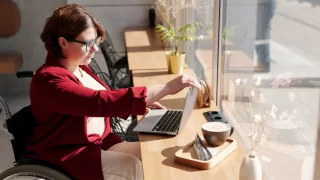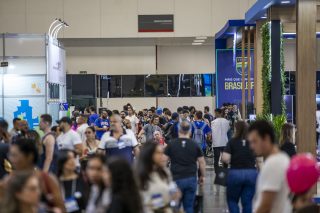
Set up at the Direct Borrachas booth, the unit will give visitors the opportunity to experience the difficulties faced by people with reduced mobility.
São Paulo, June 2019 – What is it like for a person with mobility issues or a visual impairment to move around a house prepared to welcome them? This is the purpose of the “Accessible Architecture Concept House,” designed to promote awareness about the relevance of accessibility in spaces and sensitize people to the importance of specific equipment installed in areas where they will move around.
The Concept House will be set up inside the Direct Borrachas booth and will be available for visitation during the Reatech – International Fair of Technologies in Rehabilitation, Inclusion and Accessibility, which will take place at the São Paulo Expo from June 13 to 16, and will feature guided tours of each environment, where specialized professionals will explain the solutions.
The purpose of the project is to show not only the importance of designing and building spaces that already incorporate accessibility issues, but also that an accessible home is a space for everyone. “For every barrier encountered, there is the possibility of arranging accessibility solutions, whether with products or services,” says Jéssica Jacqueline, director of Direct Borrachas, the company carrying out the project.
The idea to create this space came from accessibility specialist architect Gabriella Zubelli. “Architecture must serve all types of people, respecting their differences. An accessible home is not exclusively for people with disabilities, but rather a space that welcomes everyone, and all ages,” says Gabriella.
Different environments
The house consists of six rooms—hall, living room, kitchen, bedroom, bathroom, and balcony—which aim to show some barriers and obstacles encountered in the daily lives of people with disabilities and reduced mobility, and their respective adaptations, as well as conceptually presenting ways to design and implement accessibility solutions based on current legislation and accessibility standards.
The visitor will also have the opportunity to experience the spaces in an inclusive and sensory way. Blindfolded or in a wheelchair, the person will be guided through the house, having the experience of feeling the difficulties encountered by those with some type of disability.
The proposal, according to Jéssica, is to bring accessibility solutions and assistive technology, as well as to demonstrate some of the daily difficulties faced by people with disabilities, reduced mobility, and the elderly. “Another proposal of the House is to raise visitors” awareness of the theme of accessibility and inclusion. To this end, wheelchairs, blindfolds, canes, and walkers will be made available so that visitors can experience the house in a different way and, with a feeling of empathy, promote a change of perspective," she states.
Autonomy for the visually impaired
Reinforcing the goal of offering autonomy to people with reduced mobility, Casa Conceito will feature Orcam MyEye, a device developed by Mais Autonomia - Assistive Technology, to provide those with visual impairments greater autonomy regarding their surroundings.
Doron Sadka, director of Mais Autonomia, explains that the system does not restore vision, but works as an aid for these people. “It is an artificial intelligence and vision device that allows easy, intuitive, and instantaneous access to information available in real time and works completely offline,” Sadka says. “It is lightweight and discreet and must be attached to the temples of a regular pair of glasses.”.
Mounted on a spectacle frame, the Orcam MyEye is capable of reading printed or digital texts in Portuguese, English, and Spanish through automatic detection—such as books, magazines, newspapers, street signs, and computer and cell phone screens—at speeds ranging from 100 to 250 words per minute, but it goes further, according to Sadka. “The system is programmed to recognize people's faces, informing their gender and even being able to name them, as well as objects, barcodes, colors, and banknotes (reais, dollars, and euros) through automatic and instant detection, in addition to telling the date and time with a simple flick of the wrist. For example, it can tell what is inside the fridge, on a medicine box, or on a supermarket shelf,” explains the executive.
Service:
16th Reatech 2019
Data:June 13 and 14 – 1 PM to 8 PM
June 15 and 16 – 10 AM to 7 PM
LocalSão Paulo Expo Exhibition & Convention Center
About Cipa Fiera Milano
Cipa Fiera Milano, the Brazilian subsidiary of Fiera Milano—one of the largest trade fair and congress players in the world, which each year attracts approximately 30,000 exhibitors and more than five million visitors—became the majority shareholder of Cipa do Brasil in 2011, giving rise to Cipa Fiera Milano. In Brazil, it organizes nine trade fairs representing the most diverse segments of the economy, such as security, clean and sustainable energy, pipes and fittings, cables and wires, occupational health, surface treatment, window frames, rehabilitation technologies, inclusion, and accessibility, among others. Among the main brands in its portfolio are Exposec, Fisp, Fesqua, Ebrats, Ecoenergy, and Reatech.
Press info:
2PRÓ Comunicação
Team email: fieramilano@2pro.com.br
Teresa Silva – (11) 3030-9463
Renê Gardim – (11) 3030-9422
Fádia Calandrini – (11) 3030-9402
Guilherme Kamio – (11) 3030-9403
Myrian Vallone – (11) 3030-9404
www.2pro.com.br