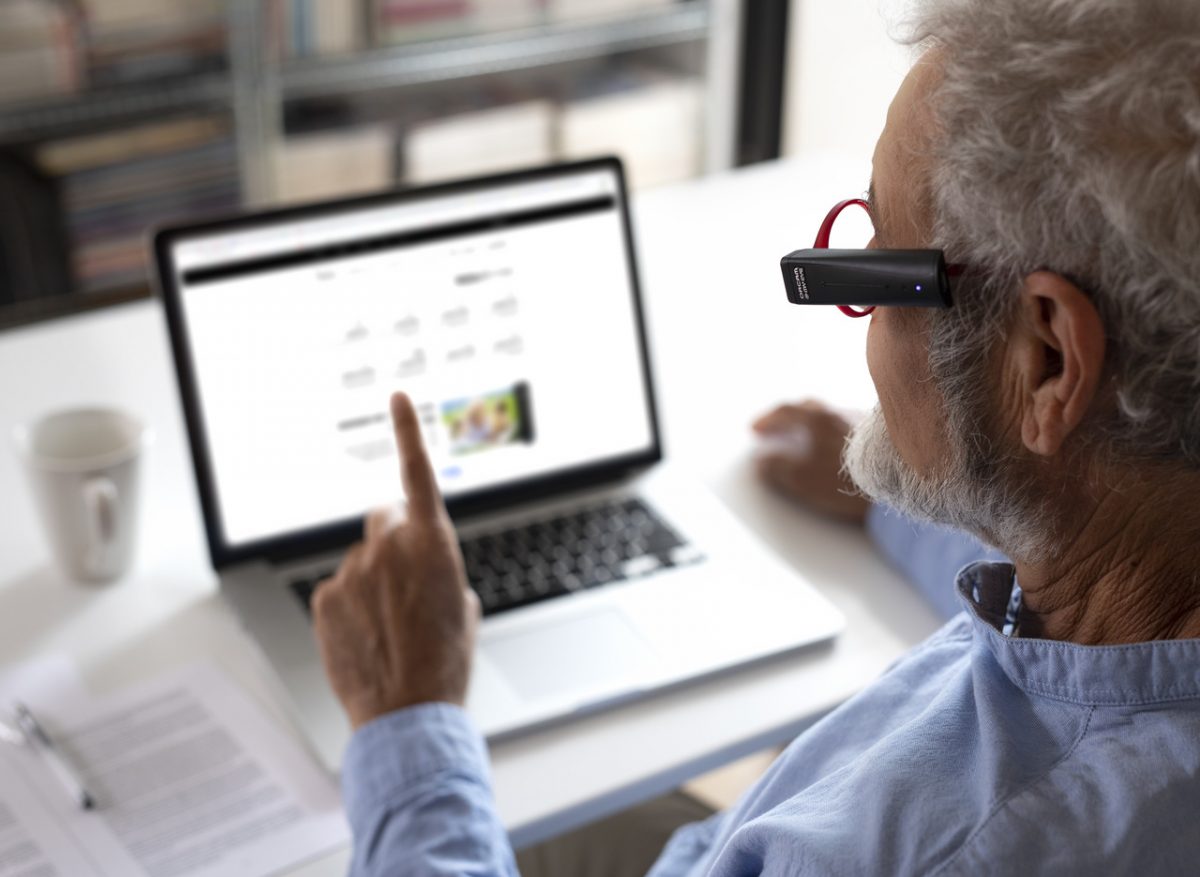
- Device has an intuitive camera attached to the frame of the user's glasses that photographs, scans, and transforms text from any surface into audio, in addition to recognizing faces and products;
- Device can be financed in up to 60 installments through the Federal Government's credit line for assistive technologies
São Paulo, January 2022 – Mais Autonomia Tecnologia Assistiva is the exclusive representative of OrCam MyEye in Brazil. Equipped with revolutionary technology, the device offers independence to blind or low-vision people. According to the World Health Organization, there are over 250 million visually impaired people worldwide. In Brazil, data from the Brazilian Institute of Geography and Statistics (IBGE) show that this population consists of 582 thousand blind people and 6 million people with low vision. And, for the most part, they have more restricted access to education, culture, and the labor market.
“About 80% of the activities we perform on a daily basis are related to reading. OrCam MyEye, as a computer vision tool, provides access to information wherever a person may be, without the need for an internet connection,” says Doron Sadka, director of Mais Autonomia, a company whose mission is to make the world’s most advanced technologies available in Brazil to people with disabilities.
The Orcam MyEye consists of an intuitive smart camera that weighs only 22.5 g and measures 7.6 cm by 2.1 cm. Attached to the frame of the user's glasses, it is capable of detecting text in Portuguese, English, and Spanish, whether in books, magazines, newspapers, menus, documents, street signs, text on cell phones, tablets and computers, packaging, store signs, and directional signs, for example. Its speed can be controlled, enabling the reading of 100 to 250 words per minute; it allows choosing between a male and female voice; and it has commands to pause, fast-forward, or rewind the reading – all of this offline.
The device is also able to identify colors and shades, recognize people and genders, faces, report the date and time with a simple wrist twist gesture, banknotes (reais, dollars, and euros), and identify products by barcode. After recognition, it discreetly transmits the information into the user's ear.
The executive explains that the Orcam MyEye broadens the possibilities for the visually impaired in the labor market, allowing them to hold previously challenging positions and offering more independence. “With the use of the device, a blind person can work in a more adapted way in various roles. For a company receptionist, for example, the device helps by revealing how many people are in front of them, whether they are men, women, boys, girls, or children, and if it is someone already registered, the device states the name through memorized identification,” he adds. The Orcam MyEye also enables the development of people with dyslexia, reading deficits, or illiteracy.
The OrCam MyEye can be financed in up to 60 installments through the Federal Government's credit line for assistive technologies, via Banco do Brasil. Mais Autonomia also officially represents in Brazil the WeWALK Smart Cane, designed specifically for the daily lives of people with visual impairments. It alerts the user, through vibrations in its handle, to unexpected obstacles at chest and head height, path obstructions, and structural pathways on streets and sidewalks, for example. If connected to a smartphone via Bluetooth, it can be integrated with Google Maps or voice assistance software to understand the surroundings and provide guidance on nearby stores, restaurants, pharmacies, or any convenience. More than a technology, WeWALK is a social movement.
More information about the products is available on the website www.maisautonomia.com.br.
Examples of Inclusion
“With OrCam MyEye, for the first time I was able to browse through books in a bookstore. It's hard to describe the feeling because many times we don't value our freedom of choice, which is so simple that we forget to remember it. This is inclusion. Being able to choose one or several ways to have access to reading,” he states. Marina Guimarães, court clerk of the Court of Justice and ballerina of the Fernanda Bianchini Association – Ballet for the Blind.
“It's going to help at school because I won't need an assistant anymore – I just have to look at the book, point or press play, and it will read for me,” she comments Giulia Rodrigues, daughter of player Roger, from Ponte Preta.
“The OrCam MyEye technology is fantastic and effective. OrCam managed to bring together in a single device everything that we look for in various mobile apps, João Anadão, systems analyst at Banco Itaú.
“One of my dreams was to sit on a subway train or bus and open my book or magazine to read like anyone else. Today, thanks to God and OrCam technology, I can do this,” he reports. Jucilene Braga, psychologist and coach.
In 2018, the City Hall of São Paulo acquired Orcam MyEye devices for all 54 libraries in the municipality. Together, they hold a collection of 5 million titles and provide a massive example of an inclusion program that democratizes access to culture, education, social life, and the labor market for people with visual impairments, dyslexia, or reading difficulties.
From 2020 to 2021, the Government of the State of Goiás acquired Orcam MyEye devices for all 152 visually impaired students in the state. Provided under a loan agreement by SEDUC-GO to the student until the completion of high school in their municipal and state public schools.
In 2021, the City Hall of São José dos Campos, in the state of São Paulo, acquired 100 OrCam devices for students with visual impairments enrolled in its schools.
Sorocaba also adopted the path of more accessible education, making 50 devices available to blind or low-vision students in the municipality.
O Government of the State of Bahia also investing in educational accessibility: one hundred students have already been provided with the device, and the goal for 2022 is to serve the remaining blind or low-vision students in the state.
The Experts' Word
Ophthalmologist Juliana Sallum, a professor in the Department of Ophthalmology at Unifesp and director of the Institute of Ocular Genetics, says that OrCam MyEye is an excellent tool for improving the daily lives of patients. “Restoring the ability to read includes the visually impaired person in society.”.
“The OrCam MyEye has enormous application potential, not only for the visually impaired, but also for people with developmental disorders and reading difficulties, whether due to brain disorders or learning disabilities. Lightweight, functional, and practical, the device enhances the quality of life for people with specific needs related to visual decoding difficulties, reports Mauro Muszkat, coordinator and creator of the Interdisciplinary Child Neuropsychological Care Center (NANI) of the Psychobiology Department at UNIFESP.
The Founders
OrCam was jointly founded by Amnon Shashua, a professor at the Hebrew University of Jerusalem, and entrepreneur Ziv Aviram, the company's current CEO. In 1999, they conceived of an autonomous car that would not cause accidents and would guarantee safety behind the wheel by creating the startup Mobileye. A benchmark in the world of artificial intelligence, the startup was sold in early 2017 for 15.3 billion dollars to INTEL, the highest price ever paid in Israeli history for a technology company.
During their research, the partners managed to develop an algorithm that enables the detection of objects within a camera's field of view. In 2010, the artificial intelligence technology they created was applied to humans with the creation of the startup OrCam. OrCam's mission is to harness the power of computer vision and wearable technology to help the visually impaired. With a market value of 1 billion dollars, OrCam intends to hold an IPO by the end of 2021.
About Mais Autonomia
Mais Autonomia Tecnologia Assistiva is the exclusive representative of the WeWALK Smart Cane in Brazil. Focused on providing greater independence to visually impaired people, the company already exclusively sells the Orcam MyEye, a revolutionary wearable artificial vision device. Both products can be financed in up to 60 installments through the Federal Government's credit line for assistive technologies. www.maisautonomia.com.br.
Press information
More Assistive Technologies Autonomy
(11) 9.7061-2134
Cleiton de Sousa – evento@maisautonomia.com.br