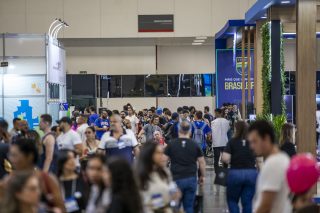
In four days, 52 thousand people visited the leading trade show in the sector in Latin America and were able to discover trends and technologies from 300 exhibitors
São Paulo, June 2019– Producing knowledge, disseminating new technologies, discussing solutions, offering entertainment and a space for networking, providing job opportunities, and generating empathy. It is with these fulfilled objectives that the 16th Reatech – International Fair of Technologies for Rehabilitation, Inclusion, and Accessibilityended on Sunday (16), cementing its reputation as the leading trade fair for the sector in Latin America. Over the four-day event, 52,000 people visited the São Paulo Expo Exhibition & Convention Center in the capital of São Paulo.
Among this edition's innovations, the major highlights were the Concept House (a home adapted for people with reduced mobility), the Reackathon (a marathon focused on accessibility solutions), and the RadCross track (a competition to encourage challenges and discover potential athletes). The public also had access to a larger test-drive area featuring major automakers.
“Reatech has once again fulfilled its role as the ideal venue for opportunities, networking, learning, and respect, bringing together attendees and exhibitors eager to experience and provide a better quality of life for people with disabilities,” says Rimantas Sipas, Commercial Director of Cipa Fiera Milano, the promoter and organizer of Reatech. “In this edition, we had 101 new companies among the 300 exhibitors, which is an indicator of the growth and importance of technology in the accessibility market.” The next edition of Reatech is scheduled to take place May 27–30, 2021, at São Paulo Expo.
Concept House
Highlighting home technologies and solutions and generating empathy for those who have never faced accessibility issues were highlights of Casa Conceito, one of the major new features of this edition, set up inside the Direct Borrachas booth. The space was created by accessibility-specialist architect Gabriella Zubelli, who simulated a six-room house aimed at people with reduced mobility. The public, either blindfolded or in a wheelchair, had the opportunity to experience the spaces in an inclusive and sensory way.
Jéssica Jacqueline, director of Direct Borrachas, stated that by Saturday, the penultimate day of the event, four thousand people had visited the booth, and three large adapted accessible housing projects were closed. “The experience of being at Reatech is sensational, both for us, the exhibitors, and for the public. We received many end consumers, construction companies, architects, engineers—a very diverse audience. Given the number of people who stopped by and the conversations we had, the outcome is very positive. We are aware that we will reap more rewards after the fair and that we will be together, without a doubt, in the next edition,” declares Jéssica.
Hackathon
If competing is more important than winning, doing good is even more important than competing. This was the spirit of the Reackathon, a marathon focused on accessibility solutions, another major new feature of this edition. With the theme “Assistive Technology for People with Disabilities and Reduced Mobility,” the competition ended up turning into an integrated action at the initiative of the competitors themselves, who became collaborators.
About 40 mentors and participants joined forces and presented, on the last day of the fair, the three projects considered most innovative and viable for the accessibility market. They are Opus (a platform that acts as a social network for people with and without disabilities to exchange various information), Movimentos Mágicos (glasses that use Virtual Reality resources to create a playful environment for children in physical and occupational therapy), and Narota (an app that uses GPS technology to help the visually impaired map their paths and point out positive and negative situations along the routes in real time).
Daniel Takaki, facilitator of the Reackathon, states that the age group of the participants ranged from 18 to 45 years, which shows that both students and established market professionals care about market solutions for the segment. “We had great support from Cipa Fiera Milano and several exhibitors, including Atento, CIEE, and Dorina Nowill, who helped us achieve innovative results through collaboration,” says Takaki.
“If all fairs have this perception and delicacy of bringing together people who are willing and able to build, many things will emerge to improve people's quality of life,” states Bruno de A. Bisogni, a developer who has competed in 45 hackathons and taken home 11 prizes. “We are not worried about the money. We want to be at a bus stop and see someone using an app we developed. That is priceless.”
RadCross and ADD Space
Wheelchair competitors racing against each other and against the clock on a track full of obstacles and ramps. The RadCross wheelchair championship, an event organized by LIVRE—a company specializing in assistive equipment—was a success with participants, featuring two amateur tournaments and one professional one, as well as with the audience.
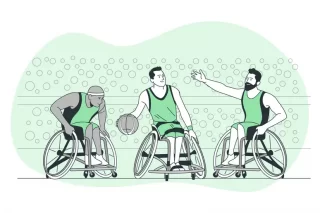
Still in the sports sector, for the 12th consecutive year, the fair featured the ADD Space – Sports Arena. At this location, concurrently with the fair, various sports activities aimed at people with disabilities were held. In total, there were over 32 hours of basketball, volleyball, handball, rugby, and badminton. The arena also featured the presence of Paralympic athletes.
Test drives and adapted vehicles
In this edition, the fair's organization decided to expand the test drive area to ensure greater comfort and safety for the public, which increasingly looks for adapted vehicles. According to data from Abridef (Brazilian Association of the Assistive Technology Industry, Commerce, and Services), over the past five years (between 2014 and 2018), the sale of brand-new cars with tax exemptions for people with disabilities more than tripled (from 84,000 to 264,000).
General Motors conducted an average of 120 test drives per day of the fair using five adapted vehicles. In the static display, GM showcased the Spin with a wheelchair ramp, where the user is hoisted into the vehicle and rides in their own wheelchair. “We’ve been following the growth of the disability sector through Reatech, which is why this event is important to GM. Visitor traffic was very good every day. People sought information about discount terms, and we offered a bonus ranging from R$ 500 to R$ 1,000, depending on the vehicle, which can be used up to three months after Reatech,” said Kleber Cruz, regional manager of Direct Sales.
Honda, which has participated in every edition of Reatech, exceeded 400 test drives during the event. “This year, we brought the Personal version of the Honda FIT, which features a seat system (Magic Seat) that allows people with reduced mobility to adjust the seat in various ways. The trunks of our cars can also accommodate different models of wheelchairs, even those that are not foldable. It is important to highlight that Honda dealerships take care of all the paperwork with the relevant authorities, and no fee is charged for this service,” said Luiz Henrique Sanches, Direct Sales supervisor.
Toyota brought the Prius and the Corolla for a test drive with manual accelerator and brake controls and a steering wheel knob, in addition to presenting 11 “user-friendly” imported accessories from Japan, which are testing the receptivity of Brazilian consumers, such as lumbar seat backs, a swivel seat (for the elderly and obese), a seatbelt extender, and a trunk lid pull handle.
Mercedes-Benz participated in the fair for the first time and stated that the results were so positive that it will be at the next event. “It is the first time we have participated in the fair; it is quite large for the segment and was a big surprise for us. We are presenting an innovative technology in the Sprinter, which is why we welcomed many wheelchair users as well as car rental owners interested in purchasing the van to make adaptations in order to transport children and adults. The event generated a lot of contacts, and now we will see if we can close these new businesses in the coming months,” highlighted Jessica Masana, the company’s Marketing and Communication Analyst.
Renault and Volkswagen offered test drives of their vehicles with automatic transmission and electric steering. Meanwhile, Fiat presented, at its booth, a Dobló with a wheelchair ramp.
For Jeep, Reatech is very important because it represents a moment of rapprochement between the brand and an audience that, deservedly, has been gaining visibility, even though there is still much to be achieved in terms of inclusion and opportunities, stated Fábio Meira, Director of Direct Sales at Fiat Chrysler Automobiles. “In addition, we are proud to have shown at the fair two competitive products that drew a lot of attention. Namely, the Jeep Renegade PCD, one of the most successful models in this market, and the Jeep Compass Longitude Diesel, an excellent option for the customer we can call Premium PCD,” said Meira.
Cavenaghi, which manufactures vehicle adaptations for drivers with some type of limitation, presented a modification that guarantees total autonomy for wheelchair users. The company exhibited a Ford EcoSport with the equipment, which is still in the certification phase. The vehicle features an automatic system for opening the rear door (trunk) activated by remote control. Then, a ramp, also automatic, descends. With the rear seats folded down, the wheelchair user goes up and positions themselves in front of the steering wheel, closes the door, and drives off without the need for any assistance. The requirement is that it must be a motorized wheelchair.
Mônica Cavenaghi, the company's commercial director, stated that Reatech is a gathering moment for people with the same purpose and offers the possibility of relationships with new clients. “The organization deserves congratulations regarding the structure of the fair. I see a more professional fair, which was a demand we had been asking for many years. We are strong partners of Reatech, it is a very important event for us, and we will think together again about new solutions,” stated Mônica.
Labor market
In a country with more than 45 million people with disabilities—most of whom are capable of contributing fully to the economy—providing opportunities for entry into or reentry into the labor market is essential for a trade show like Reatech. This need is even more pressing when 60% of people with disabilities who left their last job cited a lack of career prospects as one of the main factors behind their decision, according to a survey conducted by i.Social, in partnership with the Brazilian Human Resources Association and Catho.
For Maiara Tortorette, Marketing Coordinator at Catho, an online resume and job board company, Reatech was extremely positive for brand awareness and networking. “Our objective with the event was to promote the free platform and the My Job By Right movement. In terms of the profile of the contacts, we spoke a lot with professionals with disabilities who wanted to register for free on our platform, as well as companies that are looking for these professionals,” says Maiara.
Drawing
Another highlight of the fair was the raffle of the OrCam MyEye, one of the most advanced artificial vision technologies in the world. The device, which can be attached to glasses, instantly photographs, scans, and converts text from any surface into audio. The raffle was conducted by Mais Autonomia, the company that sells the product in Brazil.
Unprecedented insurance
Sompo Seguros, the only insurance company present at the fair, presented an unprecedented service: the only insurance in Brazil for people with disabilities or reduced mobility. "Our participation in Reatech was very positive. We had the opportunity to show that the company has innovated to bring unique solutions to the market. Our booth was heavily visited, we were the only insurance company at the event, with a unique product,” stated Marcio Martinati, superintendent of Sompo Seguros.
Alongside the fair's exhibition area, the lectures, courses, and workshops consolidated the specialized and developmental character of the sector, such as Reasem,Rehabilitation and Inclusion Technology Seminar; Reamed, Physical Medicine and Rehabilitation Congress; Tecfisio, Advanced Technologies in Physiotherapy Seminar; and Reashow, Exhibitor Lectures.
About Cipa Fiera Milano
Cipa Fiera Milano, the Brazilian subsidiary of Fiera Milano—one of the largest trade fair and congress players in the world, which each year attracts approximately 30,000 exhibitors and more than five million visitors—became the majority shareholder of Cipa do Brasil in 2011, giving rise to Cipa Fiera Milano. In Brazil, it organizes nine trade fairs representing the most diverse segments of the economy, such as security, clean and sustainable energy, pipes and fittings, cables and wires, occupational health, surface treatment, window frames, rehabilitation technologies, inclusion, and accessibility, among others. Among the main brands in its portfolio are Exposec, Fisp, Fesqua, Ebrats, Ecoenergy, and Reatech.
Press info:
2PRÓ Comunicação
Team email: fieramilano@2pro.com.br
Teresa Silva – (11) 3030-9463
Renê Gardim – (11) 3030-9422
Fádia Calandrini – (11) 3030-9402
Guilherme Kamio – (11) 3030-9403
Myrian Vallone – (11) 3030-9404
www.2pro.com.br